Overthinking Armenian visibility
Can people tell you're Armenian without you explicitly telling them? How much information do you need before you detect the 'Armenian-ness' in someone else? How visible are Armenians in your non-Armenian spaces (workplace, school, etc.)?
I've been thinking about this a lot lately. These are rather vain and chauvinistic questions to be concerned with. Can the plebeian masses, the white Anglo-Saxons, and those they've colonized into the mainstream identify that I am not merely one of the cultureless lackeys? Can they sense that I claim an ancient culture, including direct descent from Hayk Nahapet? Are my fellow enlightened compatriots identifiable to me?
I am exaggerating, but only slightly. I'm no nationalist, and I am rather uncomfortable with attempts to categorize Armenians (more on that later). In fact, I doubt that overanalyzing visible belonging to an ethnic group is a particularly good idea. But given that a person's lived experience of 'Armenianism' varies and is dependent on whether they can be clocked as Armenian while out and about, I think we can indulge in some self-centered analysis.
I'm fairly lucky that my main non-Armenian space (the University of Toronto) is somewhat Armenian-aware, at least within my program/year. This is best illustrated with a silly anecdote. An odar (non-Armenian) girl attempting to make small talk with my lab partner asked him if he was Armenian. He was not, but I (a real Armenian!) was standing temporarily undetected next to him. The odar girl's reasoning for asking him the question upon meeting? He had dark hair, dark eyes, and pale skin, similar to another Armenian classmate.
“Can people tell you’re Armenian without you explicitly telling them? How much information do you need before you detect the ‘Armenian-ness’ in someone else? How visible are Armenians in your non-Armenian spaces?”
The fact that the ~2.745 (± 0.55) Armenians within our cohort of over 500 persons (based on the last count of blood quantum) lay claim to such a common and ordinary phenotype without much effort suggests something about our ability to gain visibility. But 'blood quantum' is an invisible and quite frankly pointless metric, and not a traditional way of measuring belonging to the Armenian community. So when we're measuring who is visibly Armenian within a non-Armenian space (including UofT), we are looking at other characteristics.
During my first year of university, a professor did an in-class exercise where students were invited to share if they spoke any languages besides English. After much internal debate about whether: my linguistic abilities allowed me to claim to speak Armenian; and if it was a good idea to out myself to a lecture hall of 100+ people.
I raised my hand and told the professor that I spoke Armenian, so it could be added to a list that already included Russian, Turkish, and several dozen other languages.
The prof made a point to ask me if my last name ended in '-ian' or '-yan'. Satisfied that my Armenian identity was confirmed, he then moved on to the point of this exercise. Turns out, our class of first year students collectively speaks several dozen languages! But individually, even the most linguistically capable student in the class can only claim fluency in a maximum of four languages (and even that was a bit disputed). Lesson learned: Don't compare yourself to the collective. You will never manage to check all the boxes they do as a single person.
So what collective standard is set to be able to identify individual Armenians? In my personal experience, there are several key points. These include, but are not limited to: speaking Armenian; having an Armenian first and especially last name; looking stereotypically 'Armenian'; having a connection to the modern Armenian state (such as visiting Armenia in the summer or having relatives there); partaking in Armenian cultural activities (dance, music, etc.); displaying Armenian symbols (Mount Ararat, pomegranates, etc.); and participation/attendance at Armenian community hubs (Armenian churches, schools, etc.). I'm sure I missed one or two, or perhaps ten, other potential external markers of Armenian identity. Still, this list is pretty representative of what I've noticed makes other Armenians visibly Armenian.
Of course, we are always quick to defend against false negatives. Not all diasporans speak Armenian! Not all community members attend church! Some Armenians don't have Armenian names!
These are all valid points. However, no individual is required to check all the collective boxes. Usually, checking one box is enough to be outed as Armenian. These checkboxes are not a moral evaluation of patriotism or a scientific verification of Armenian identity. These are just potential ways to show Armenian identity externally.
Strangely, there is not much anxiety around false positives, like in the case of my lab partner. I guess because a false positive is a harmless statistical anomaly. Neither the Armenian-assumer nor the Armenian-assumed is harmed.
Obviously, this is not the case in more hostile environments. A few years ago, I met an Armenian girl from Istanbul through a diasporan youth program. She had a very Armenian name, and she told me she made sure to never mention it when asked about it. When she was asked about its origin (because it was an unusual name in Turkey), she'd simply say it was her grandmother's name. This was a convenient lie by partial omission, in the interest of protecting her safety and comfort.
So, can we choose whether we are visibly Armenian? Is it possible to conceal our identity?
I didn't really realize how visibly Armenian I was until I got to university and was surrounded by people culturally literate enough to pick up on it. The TAs checking my ID before grading me could tell I was Armenian from my last name. Anyone asking about which languages I speak will figure it out. Discussions about summer break itineraries and future travel plans will give it away.
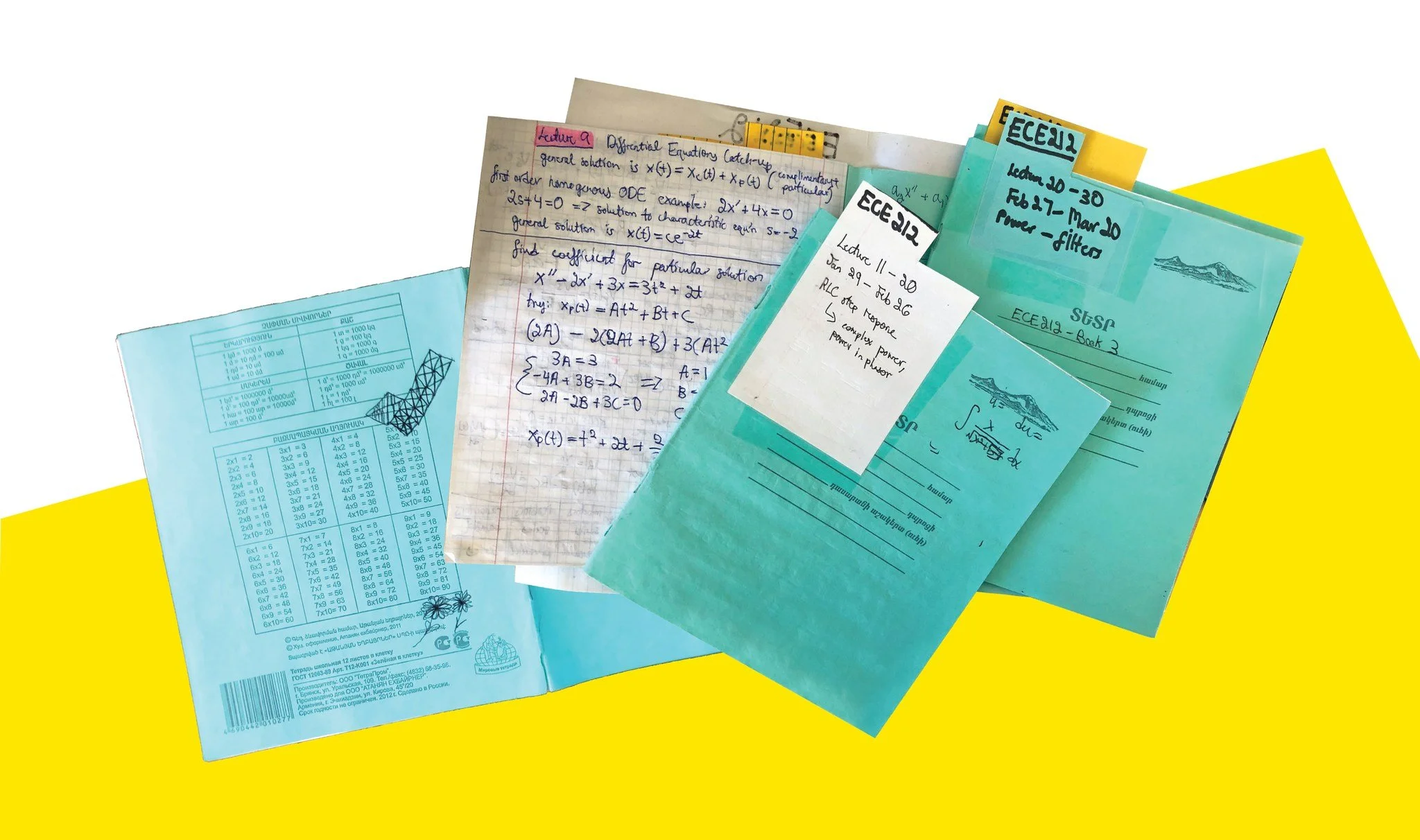
So to fully conceal my identity, I would need to lie about my summer plans, my future aspirations, my linguistic capabilities, and change my legal name. That's a lot of effort, and I'm fortunate that my environment is safe enough for me to avoid taking those precautions. In fact, it's often beneficial to out oneself as Armenian to find community. I've had an Armenian classmate reach out to me after noticing my profile picture in a group chat was of Neil Hauer, a Canadian journalist who covers Armenian issues on the ground. I can confidently display Armenian symbols without fear, including Armenian data analysis projects on my resume, and Mount Ararat on my notebooks usually results in positive reactions from Armenians and allies.
There's a temptation now to begin to create categories of Armenians based on their ability to choose their visibility and how their environment reacts. It's tempting to compare the differences in lived experiences. If I were more self-indulgent, I would do a full ethnocentric over-analysis, complete with a graph: level of environment hostility in the x-axis vs default Armenian visibility in the y-axis. We could logically derive a good way to categorize the practical ways Armenian identity impacts day-to-day life.
The issue with this analysis would land me in the same quadrant as Kim Kardashian. Both of us live in diasporic communities in Armenian-friendly North America, and both of us are visibly Armenian by default. However, I'm not sure if my everyday reality is similar to that of a billionaire media personality.
Categorizing Armenians, even when based on what seems like objective differences in lived experiences, proves to be a futile effort. I can find a million and one ways my experience of 'Armenianism' differs from the other Armenians who share my non-Armenian spaces. It reaches a point where I need to ask why I'm doing this. Is this to gain clarity, empathy, and understanding of the varied circumstances Armenians face? Or is this to isolate myself arbitrarily? In short, is this a tool to build stronger and more inclusive coalitions that cater to different Armenian realities, or is this an excuse to opt out of connecting with people who don't perfectly fit my version of Armenian experience? Am I enabling connection or killing it?
My poor lab partner has been the victim of my ethnocentric over-analysis for nearly a year. After my article on beauty culture was published, we were discussing the need to preserve ethnic features. We agreed that external markers of identity are essential. But he claimed he could tell I was Armenian without relying on physical appearance, last name, or patriotic self-admission. Apparently, my behavior was enough to give it away.
“There’s a temptation now to begin to create categories of Armenians based on their ability to choose their visibility and how their environment reacts. It’s tempting to compare the differences in lived experiences.”
Behaviour? We were interrupted before I could ask him to clarify.
Behaviour like the self-important over-analysis of one’s own culture? Superficial behaviour like gesturing erratically?
Are these behaviours contagious? Will you start triggering false positives if you spend too many consecutive Friday nights writing hardware description language with me?
He never gave a specific answer. It doesn't matter. I'm not going to change. The boxes will be checked. I will be identifiable. I will raise my hand to be sure of it. And I'll include everyone else in my vision. ֎
This article was published in Torontohye's Oct. 2025 (#218) issue.