Always home: Reflections on the 2025 Pomegranate Film Festival
My 20-year-old son doesn't speak Armenian.

I had told myself for years that's why we didn't belong at community events anymore. I felt shame each time I had to explain why I'd married outside the culture or why my kids grew up speaking only English. The life choices I made had consequences. I accepted that the door was closed. Safer that way.
But on Sunday evening, after volunteering all weekend at the 18th Pomegranate Film Festival (POM), my son Nate joined me at Hamazkayin Theatre for the final awards ceremony. He's always been curious about his heritage—the only one of my two kids who climbed to the top of the Cascade during our 2019 trip to Yerevan, asking questions I didn't always know how to answer. I had pulled away from community for so long that I'd never shown him how to belong to something I barely believed I deserved myself.
When the ceremony ended, and volunteers started breaking down to get the cafeteria and front entrance ready for school the next day, I asked if he'd help stack chairs. He said yes, working alongside people who'd been doing this for years, like he'd always belonged there.
"This is actually pretty cool, Mom," he said quietly while we worked.
That's when I understood: The story I'd been telling myself—about not belonging, about doors closing, about consequences—wasn't true.
A week of stories worth telling
The 18th edition of the festival ran November 10-16, splitting between online screenings early in the week and in-person events at Toronto's Hamazkayin Theatre. Nearly 30 films from 10 countries. Over a dozen Canadian and North American premieres. Twenty filmmakers who travelled from around the world to be here, all supported by an entirely volunteer operation run through the Hamazkayin Klatsor chapter.
I had shown up to volunteer for the first time, unsure what to expect. A lifelong cinephile whose early career was in film and TV production, offering my hands to help felt like a homecoming in more ways than one.
What I witnessed was cultural preservation happening in real time. High school students scanned tickets for graduation credit, working alongside organizers who started the same way—former students who kept coming back. Here was a team that understood what the word ‘committee really means: commitment, year after year, taking time from work and families to bring these stories home.
Between volunteer shifts, I had the privilege of watching select films, stories of resistance, survival, and unexpected joy. Three films in particular showed me what it means to carry culture forward.
The film that changed the room
When Eric Nazarian's “Die Like a Man” screened Saturday afternoon, you could feel the audience's hesitation. A film by an Armenian filmmaker that's not about Armenians? About gang violence in working-class Los Angeles?
By the time the credits rolled, they were on their feet.
The film follows Freddy, a teenager caught between a gang mentor and his desperate mother. It's unflinching about what it costs to perform masculinity where tenderness gets you killed. Before the screening, Academy Award-nominated director Atom Egoyan appeared via video to introduce his friend's Canadian premiere, setting the tone for an afternoon that felt more like a reckoning than a film screening.
The film received both the Audience Choice Award for Feature Film and an Honourable Mention from the Festival Jury. Nazarian's acceptance speech named what I'd been feeling all weekend. "Cinema is my religion, and the movie theatre is the church," he said. "You come to get an experience, to walk out, and hopefully be moved by a spiritual act. Without you, movies cannot exist."
Raising his award toward the crowd, he added: "Here's to reclaiming the Armenian narrative in a way that can transcend our own narratives and unite people together."
Reclaiming the Armenian narrative. Not replicating it perfectly, but carrying it forward in whatever form it takes.
Art as resistance, joy as revolution
Zara Jian's documentary, “I Shall Revenge This World With Love - S. Paradjanov,” taught me something I've been trying to articulate for years.
The hybrid documentary braids Jian's journey after the 2020 Artsakh War with the story of Soviet-Armenian filmmaker Sergei Parajanov, who refused to let authorities silence him, choosing creation over destruction. The film's title comes from his philosophy: avenging the world with love.
During the Q&A, Jian described how the film came together in nine months—impossibly fast for a documentary of this scope. "Everything happened as it should," she said. "It was running faster than I was able to keep up with it." Even major filmmakers who had stopped giving interviews, such as Serbian filmmaker Emir Kusturica, rearranged their lives to participate.
When the work is about cultural survival—about making art when the world wants you to make war—people say yes to things they typically wouldn't.
And sometimes resistance looks like celebration
The festival’s gala screening of Angela Asatarian's “A Winter's Song” offered a different kind of reclamation. This romantic comedy follows aspiring singer Liana (played by Armenian-American singer-songwriter Krista Marina), who discovers a world of music, culture, and love while travelling in Armenia.
The production values were exceptional, showing our homeland on what seemed like the most perfect weather days. At the packed gala, three generations sat in the same room, all responding to a story that showed Armenians on screen simply enjoying life—reminding us that our stories include more than genocide narratives and diaspora grief.
Following the screening, Krista Marina performed live, joined by Toronto-Armenian musicians Sevag Avakian and Emil Khachaturian. They delighted the crowd with new songs from the film that somehow still felt as familiar as the classic songs Marina wove into her set.
This year's festival featured a record 11 feature-length comedies. Maybe refusing to tell only stories of trauma is its own act of resistance. Maybe we've earned the right to see ourselves happy.
Stories from everywhere, for everyone here
What struck me most wasn't just the range of films, but who showed up to see them. The festival's slate reflected the richness, complexity, and creativity of Armenian cinema, bringing together filmmakers from Armenia, Canada, the United States, Europe, the Middle East, and Australia.
The awards were presented by this year's Jury, chaired by Silva Basmajian, former Executive Producer at the National Film Board of Canada, alongside Raffi Asdourian, Lucy Babayan, and Armen Poladian.
Here is a partial list of the 2025 Pomegranate Film Festival Award Winners:
Dr. Michael J. Hagopian Award for Best Feature-Length Documentary: My Sweet Land, directed by Sareen Hairabedian. In 2024, the film was pulled as Jordan's Oscar entry after pressure from Azerbaijan — underscoring why festivals like this matter as safe spaces where Armenian stories can be told without censorship.
Best Feature Film: The Marching Band, produced by Robert Guédiguian.
Best Comedy Award: Master of Destiny, directed by Grig Vahramyan.
Best Short Film: 9.1.6, directed by Hrachya Zakaryan.
Best Short Documentary: What Will Become of Us, directed by Stephanie Ayanian.
Best Children's Film: Palma 2, directed by Ruben Dishdishyan.
Rising Star - Pomegranate Aril Award: Presented to Tigran Tovmasyan (The Circus Lion) and Toronto's own Artur Andonian (Long Time No See).
Note: The complete list of Audience Choice Awards and Honourable Mentions can be found on POM’s official website: pomegranatefilmfestival.com.
What it takes to continue
That infrastructure—the airport pickups, the meals, the screening venues, the volunteers managing every detail—doesn't just appear. It's built and rebuilt every year by people who believe our stories deserve to be seen.
Angela Asatarian, recipient of this year's Golden POM Award for her work in Armenian cinema and winner of the Audience Choice Award for Best Documentary for “The Armenian Spirit”, spoke about the volunteers and sponsors during her acceptance speech: "From picking us up from the airport, to taking care of us... all of these amazing gifts—you guys have truly made us feel special." She paused, looking out at the crowd: "If we make a film and there's nowhere to see it, nowhere to show it, what are we going to do with it? Just put it in the closet? So you know, thank you, guys, for giving us this opportunity to show the films on the big screen."
You were always home
When I told Eric Nazarian the weekend felt like a homecoming, he looked at me and said simply, "You were always home."
He was right.
I'd spent years believing I didn't belong because I'd made non-traditional choices. But standing in that theatre, watching my son pitch in, talking with filmmakers who'd travelled from around the world to be part of this—I understood something fundamental.
The door was never closed. I just stopped knocking.
The 19th edition is already scheduled for November 9-15, 2026. I'll be back—this time with both my kids, Nate and his sister—because they were always home too. They just needed someone to show them where the door was. ֎
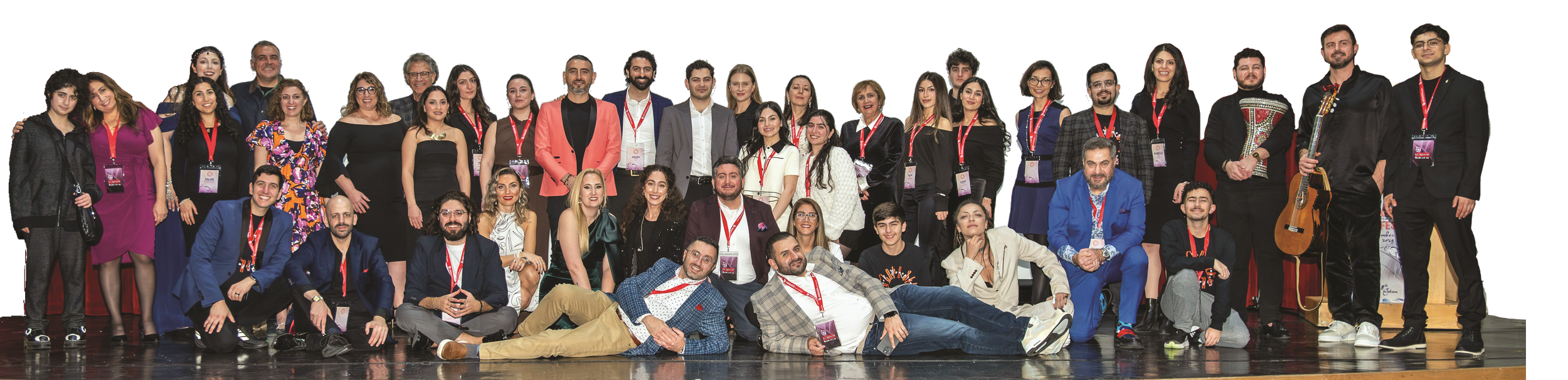
Pomegranate Film Festival committee members, jury members, and volunteers with participating filmmakers, actors, and performers (Photo: Pomegranate Film Festival)
This article was published in Torontohye’s Dec. 2025 (#220) issue.