Thanksgiving of belonging (between Toronto, Yerevan, and a Greek island)
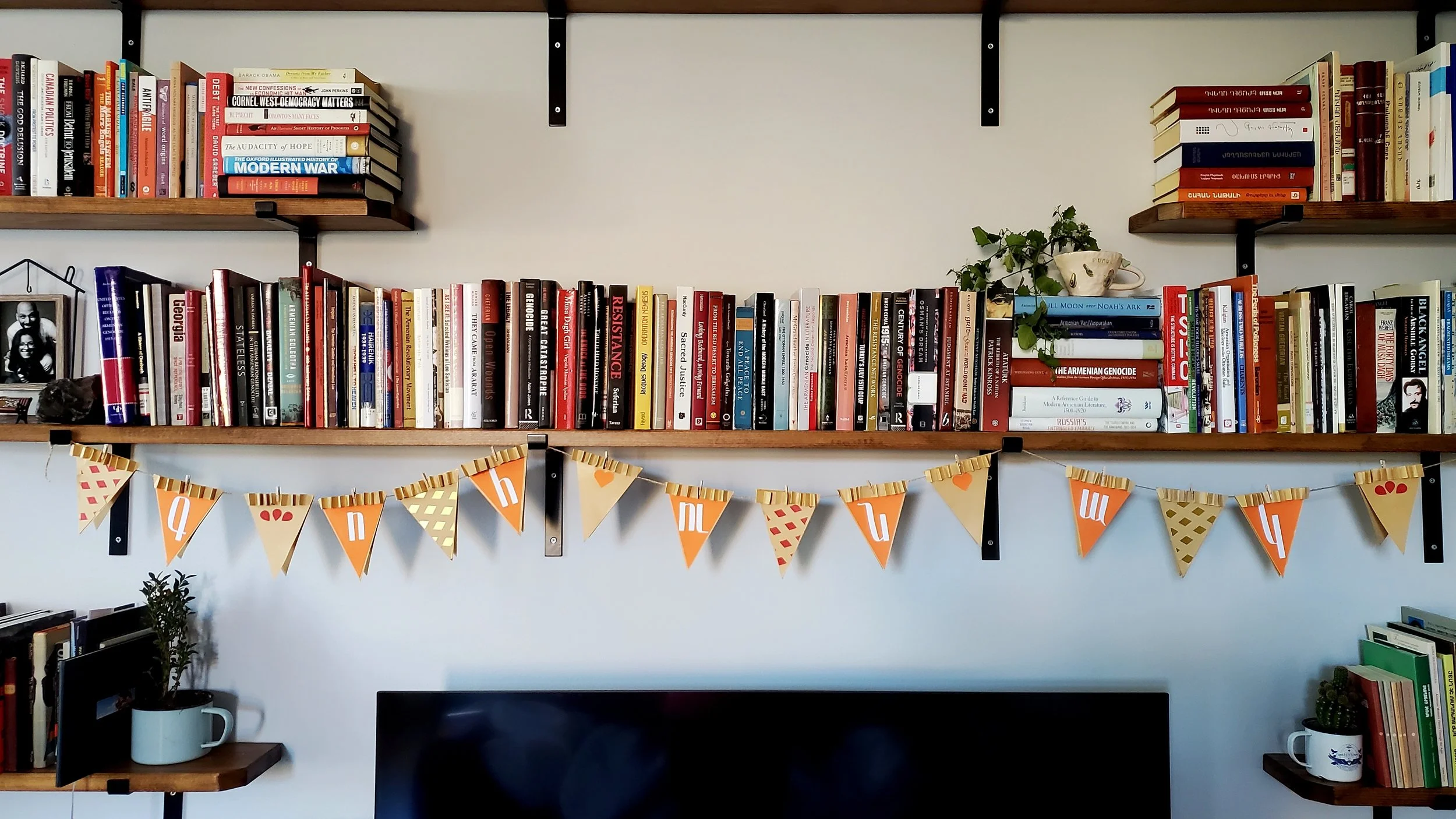
«Գոհունակ»/'Grateful'; Thanksgiving for a cause, Yerevan, 2023
It's Thanksgiving. I happen to be on a Greek island this year, where the sun still feels like summer and the sea shows no sign of autumn. It could almost be paradise (if paradise also involved trying to meet deadlines between swims). Still, I feel more productive here. It is easier to think, to write, and to breathe when the view is a vast stretch of different shades of blue and the air itself seems to insist on slowing down.
It may not feel like the Octobers of Toronto, yet Thanksgiving still finds me. It always does.
I grew up with the Canadian version of Thanksgiving: mid-October instead of late November, a celebration of the harvest and what we were grateful for, not of pilgrims and star-spangled banners. Sunday dinner at the Janbazian Residence was always a full house. Stacks of börek and sarma sat proudly beside the traditional turkey, and my mom's kadayif took the place of pumpkin pie. Cousins argued over the wishbone, and before dessert, one of the adults would remind us to go around the table and say what we were thankful for (classic!). Back then, gratitude felt like a formality. You took your turn, said the obvious, and then moved on to the sweet table.
gratitude is not a list, but a set of ties.
gratitude is not a list, but a set of ties.
Living in Armenia taught me that gratitude is not a list, but a set of ties. Some are tight and warm, like the friends who have become family. Some are knotted, like the hard parts of our recent history. Some are frayed and need mending, like the moments when homeland and diaspora speak past each other. But they are ties that keep me in place, even when I am far from it.
Over the years, Thanksgiving kept changing shape. In Watertown, fellow 'orphaned' friends (i.e., friends living away from immediate family) gathered in my small attic apartment, sharing leftovers and stories from home. In Armenia, it began quietly after the 2020 war, with a take-out rotisserie chicken and heavy hearts, but soon grew into new traditions: friends, laughter, deep-fried turkey trips out of town, and even a fundraiser dinner at our place for displaced compatriots. Somehow, gratitude always finds its way back.
I am grateful for Toronto, the city that raised me in Armenian, but also made me very Canadian. It gave me a school that taught our alphabet, a community centre that taught responsibility, and a newspaper I now edit from abroad. But Toronto also gave me Canadian values (like fairness, community service, a sense of shared responsibility, and, of course, saying sorry all the time, warranted or not) and a civic pride that made me love my city for its mosaic, not despite it. It's where my grandparents and parents planted roots after leaving everything behind, and where my peers are now the ones planning community centre expansions, running its programs, and paying its electricity bills. On Thanksgiving, I prefer to measure a diaspora by the hands that stack chairs at the end of an event, by the parents who still choose Armenian school, and by the teenagers who will someday realize their first trip to Armenia marked them more deeply than they knew.
I am grateful for Armenia, not because it is easy, but because it is real. The language on the street is ours. Our mountains set the horizon of every day. The news can break your heart, and yet the morning markets hum in Armenian, the persimmons return in season, and neighbours still check in when trouble brews. Gratitude here is a form of defiance. It is knowing that the country's leadership may falter and its politics may often fail its people, yet still believing this land is ours to love, rebuild, and defend. That belief—stubborn, imperfect, and deeply human—is what keeps this place home.
I am grateful for the bridges between the two. Some are flights full of students and volunteers. Others are quiet lines of care that cross time zones: a call to check on a friend, a donation that keeps a small project alive, an article that explains Armenia to someone who has never been. We can argue about strategy another day. Today, I am content to notice the ordinary acts that hold a people together. They are small, and they are everything.
I am also grateful for our stubbornness. The same stubbornness that refuses to treat our language like a museum piece, that keeps our schools running, that keeps Torontohye in print 20 years after its launch, through financial strain, printer shutdowns, and changing reading habits. When an Armenian teenager in Toronto does their best to speak Armenian, even if it's imperfect, I give thanks. When they write with spelling mistakes but with heart, I give thanks. When an elder corrects a verb gently, I give thanks. When we sing the wrong note and keep going, I give thanks. Living languages—and living communities—survive because people use them, imperfectly and with love.
There is another kind of gratitude that comes with loss: the places we cannot visit, the friends we cannot call, the graves we can only reach in memory. Each asks something of us: to remember without becoming bitter, to work without becoming numb, and to honour what was taken by building what can still be built. I am not thankful for the loss, but I am grateful for the clarity it can bring, and for the hands that pull us back to our feet.
Canadian Thanksgiving always falls on the second Monday in October, just two days after the Feast of the Holy Translators (Թարգմանչաց տօն), which celebrates the creators of our Armenian alphabet. The two have always felt connected to me: one a day of gratitude, the other a day of words, the tools through which we give thanks.
This year, I will buy our pumpkin a little late, because I am not home in Yerevan. When I return, it will serve as our small piece of Thanksgiving, harvest, and autumn décor—something bright to warm our home as it ripens, softens, and sweetens, until it's time to turn it, with care, into ghapama. Before bed, I will make one more list, not of comforts, but of commitments: to write carefully, to teach when I can, to keep our bridges open, to help a kid find their place in a sentence, to try to keep the faith.
Thanksgiving, at its best, is not about plenty, but about belonging. Mine stretches from an Armenian Community Centre in Toronto to an apartment in a Stalin-era five-story in downtown Yerevan, with a stop on a breathtaking Greek island.
Thanksgiving, at its best, is not about plenty, but about belonging.
Thanksgiving, at its best, is not about plenty, but about belonging.
If you are reading this from Toronto or Yerevan, Montreal or Beirut, Los Angeles or Jerusalem, I hope yours stretches just as far, and that gratitude finds you wherever you are.