An afternoon with three Canadian-Armenian authors: Dr. Alan Whitehorn, Dr. Lorne Shirinian and Dr. Keith Garebian
By Shaké Koftikian, Tamar Matig, and Eugenie Parsekhian
The Hamazkayin H. Manougian Library was bustling on April 14, 2024. A space packed with seated and standing curious and avid readers, it was a celebratory day. The Hamazkayin Library Committee was honouring Dr. Alan Whitehorn, Dr. Lorne Shirinian and Dr. Keith Garebian, three widely published, revered and illustrious Canadian-Armenian authors. Each a descendant of survivors of the Armenian Genocide with incredible talent for the written word and a conviction to tell the stories of their common ancestry. The audience entered their literary worlds over the course of the afternoon, learning about the authors, their accomplishments, contributions and latest works.
Principal Raffi Sarkissian of the ARS Armenian Private School emceed the event, introducing the authors, presenters, and readers. He situated the event in the significance of the authors’ contributions to the study and remembrance of the Armenian Genocide and its transgenerational impacts. He expressed that the authors “have contributed a wealth of literary work that is the embodiment of the thoughts, feelings, struggles, triumphs and tribulations of the Armenians in the diaspora. Moreover, these three authors have contributed their works and their expertise in benefit of our collective pursuit for justice for past and present day injustices.”
Tamar Matig, Eugenie Parsekhian and Shaké Koftikian, three members of the Hamazkayin Library Committee and professionals in their respective fields, each had crafted a presentation to introduce one of the authors and share their thoughts and impressions on their recent publications.
Seven shining students from @arsarmenianschool Lapoyan High School–Nariné Artin (grade 9), Karina Sarkissian (grade 9), Alexia Telian (grade 10), Tamar Cherkezian (grade 9), Palig Asadour (grade 11), Araz Charshafian (grade 9) and Lori Agop (grade 9) – had prepared to read aloud select excerpts in poem and prose from the publications.
Tamar Matig approached the podium first and introduced Dr. Whitehorn, reviewing his biography and academic contributions throughout his career as Professor Emeritus in the Department of Political Science and Economics at the Royal Military College. She shared the story of how Dr. Whitehorn had unintentionally become a scholar of the Armenian Genocide: as Dr. Whitehorn had written in his article 'The Birth of a Genocide Scholar' in Armenian Weekly, he had researched issues from the Toronto Globe Newspaper from 1915 out of curiosity and learned how much Canadian society had been exposed to the Armenian Genocide. Then, one day, as a senior official from the Turkish Embassy had written a letter to The Globe denying the Genocide, Dr. Whitehorn responded, using all the proof that he kept archived as a means to refute this claim. Matig then elaborated on the impact that his grandmother, Sirhoun, had on him as a survivor of the Genocide, reciting two of his poems to the audience, 'Medzmama' and 'Sirhoun’s lament'. She pointed out the transgenerational trauma evident in the poems, connecting it to what Armenians are collectively feeling today and that we all feel Sirhoun’s pain.
She then presented Dr. Whitehorn’s poetry books, The Armenian Genocide: Resisting the Inertia of Indifference (written with Dr. Lorne Shirinian, 2001), Ancestral Voices: Identity, Ethnic Roots and a Genocide Remembered (2007), Just Poems: Reflections on the Armenian Genocide (2009), and elaborated on his two most recent and bilingual publications: Return to Armenia (Վերադարձ դէպի Հայաստան), 2012 and Karabagh Diary: Poems of the Diaspora (Ղարաբաղեան Օրագիր։ Բանաստեղծութիւններ սփիւռքից), 2022. She shared a personal story, explaining how she had accidentally come across Dr. Whitehorn’s book The Armenian Genocide: The Essential Reference Guide when she was still in college, and how finding his impressive piece of work had paved the way for her decision to study history in university, and sparked her interest in the topics of books on Armenian subjects. The book itself is an encyclopedia of the Armenian Genocide, and she strongly recommended the audience to pick up a copy as there were limited quantities available. Thanking Dr. Whitehorn for his impact on her path, she invited Nariné Artin and Karina Sarkissian to recite two of his poems: 'Last of the Armenians' («Վերջին հայը») and 'Seeing Karabagh again?' («Նորից կը տեսնե՞մ Ղարաբաղը»).
Eugenie Parsekhian introduced the second author, Dr. Shirinian, a professor Emeritus of over 35 years of experience in teaching language and literature at the Royal Military Colleges in Montreal and Kingston. Dr. Shirinian is the founder and editor of Manna: a review of contemporary poetry and the author of 32 (and counting) books, making him the most prolific Canadian-Armenian author. Dr. Shirinian is the son of two orphaned children of the Armenian Genocide. And as many authors write of their experiences and perspectives, his works often are themed around the exploration of the search for one's identity as a diasporan and the burden of carrying such a heavy history. His works span a variety of genres including poetry, plays, novels, non-fiction and more.
Parsekhian spoke of and read from several of Dr. Shirinian's most recent publications:
• Two poems were recited from Dr. Shirinian's fifth book of poetry, Rendering the Timeline. It is a collection of poems spanning over a decade.
• In Intimate Spaces, a longer form of fiction, the author explores the questions ‘How do we make sure that the Armenian Genocide is remembered?’; ‘What will we do with those memories?’; ‘How do we make sense of them and keep living with the pain that we’re tasked to carry?’
• In Arising, a book consisting of two novellas and a one-act play, Dr. Shirinian engages with change through his characters;
• In Remembering, a biographical, but partially fictionalized book, Dr. Shirinian not only recounts episodes from his life, but comes face to face with existential thoughts that creep into his writing.
• The title and main character of Dr. Shirinian's most recent novella, Minas Delirian, is named after the grandfather he never got to know. This book is an effort to keep his name alive, a sentiment many Armenians feel keenly.
To conclude, Parsekhian informed the audience of Dr. Shirinian's most recent work, Troubled, a murder story that involves two Armenians in the Don Valley near Pottery Road, where he grew up. The book is expected to come out this summer. She also asked the author about his preferred form of writing and how the form of literary expression changes how one writes. Dr. Shirinian replied that although he is "...getting a great deal of pleasure in writing non-fiction these days, poetry remains [his] favourite". As many survivors of terrible atrocities cannot and refuse to speak of it, it is perhaps appropriate that poetry is the best avenue to learn of it, with few, but impactful words that shape one's imagination and emotions.
Shaké Koftikian introduced and welcomed the third author, Dr. Garebian, back to the Community Centre and Library. Dr. Garebian is a revered and widely-published author, poet, academic, and critic with numerous accolades and achievements, including having been awarded the prestigious William Saroyan Medal.
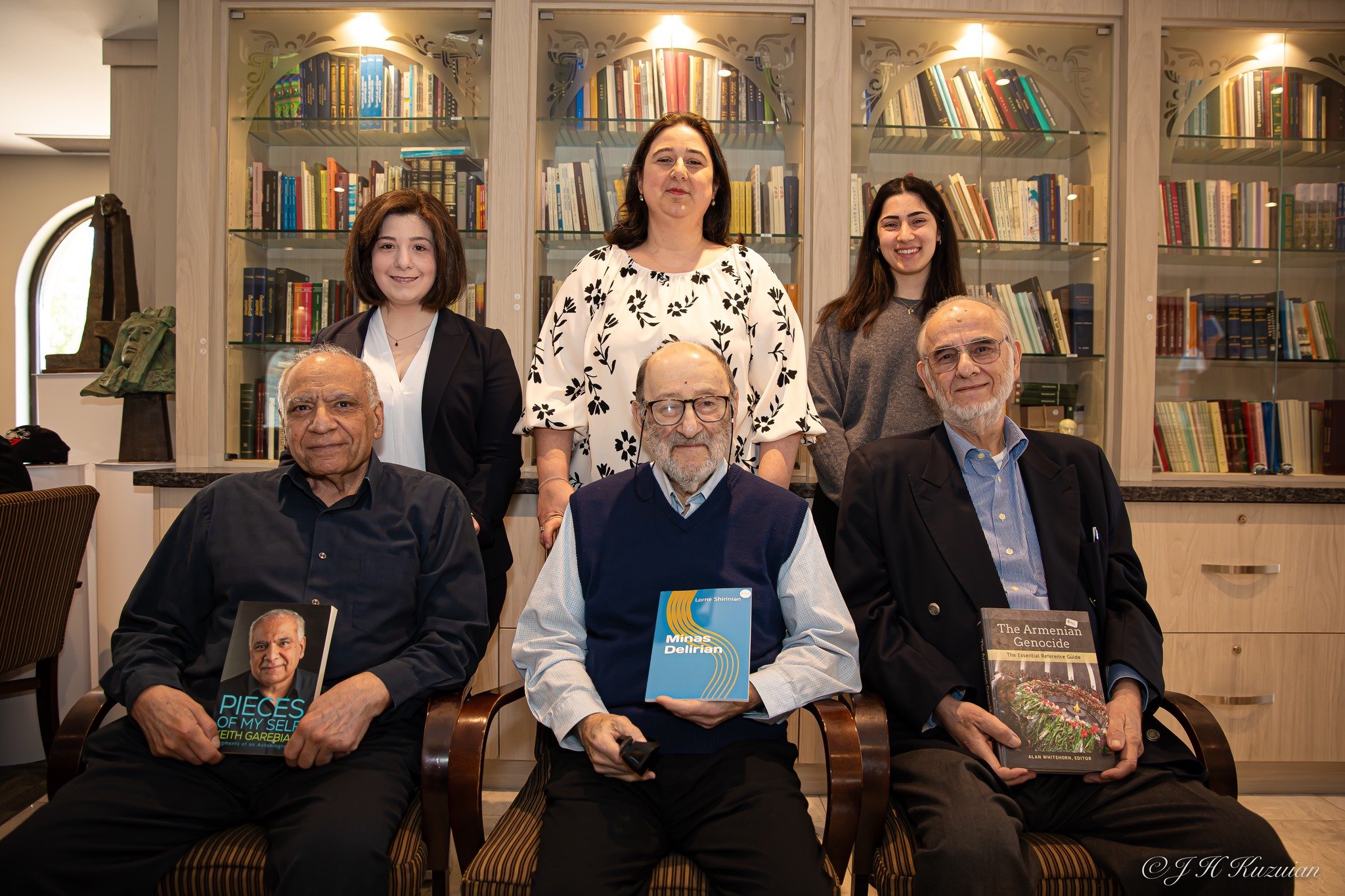
Photo: Hagop Kuzuian/Hamazkayin Klatsor chapter
Koftikian shared her personal first impressions, thoughts and reflections on Pieces of My Self: Fragments of an Autobiography. She was intrigued by the title and descriptor, wondering, at first glance, “about the curation and provenance of his narrative.” Dr. Garebian, being the son of an Armenian father and Anglo-Indian mother, acknowledges his hybrid identity in a deliberately honest, refreshing and inspiring way in his book. The reader is a time traveller as he reflects on his childhood, adolescence, immigrating to Canada, academic pursuits, passion for film, theatre and poetry, and provides insights into the sequencing of his publications. He shares intimate letters, photos, countless stories and friendships with the reader.
• Pieces of My Self: Fragments of an Autobiography is, in Koftikian’s words, an autobiographical venture wherein “Dr. Garebian masterfully creates a dynamic with the reader in piecing his life experiences with storytelling that invokes all the senses and compels questions, remembrance and active reading…it is generous with Dr. Garebian’s telling of his encounters with numerous actors, writers, academics and artists.”
She commented: “From childhood, Dr. Garebian’s fascination with books has grounded his sense of place…For fellow keen readers and bibliophiles, Dr. Garebian’s is an impactful and inspiring story. I was transported. His latitudes and longitudes are positioned in his works, and his sense of place has also grounded his sense of self, albeit always fluid, continuous and straddling between multiple worlds and worldviews with reflections that bridge them in the most personal and authentic way…Through his words, the reader can see and feel how he grapples with his sense of identity.” A key takeaway as a reader, she found that Dr. Garebian’s “sense of identity permeated all aspects of his life…”
Koftikian asked Dr. Garebian what advice he had for diasporan Armenians who are journeying to understand their own identity, to which he replied: “…get to discover your ancestry. That is the point where your identity began even though you may not know what your identity is fully. I don’t think anybody does. Learn the history of your forebears. No man is an island unto itself. The world is large, far flung, but reading and communication help shrink it…read good writers, difficult writers, writers who leave a space for reflection, writers at odds with your own worldview…expand your reservoir of memories…to know oneself is to know others and vice versa. Remember that reading is a form of travel. It is a journey. And every journey is an act of displacement, of immigration, of exile or self-exile. Life is motion…”
Following the presentations and Q&A, the library was bursting with attendees who were purchasing books, meeting the authors and asking them to sign their copies. Light refreshments were available at this time of mingling. One could hear a peppering of “Well done!”, “Wonderful!” and “Marvellous!” around the library. It was a spectacular event, well attended and well received by the authors and attendees alike.
All the featured publications are available for sale at the Hamazkayin H. Manougian Library, open on Sundays from 10:30 a.m. to 1:30 p.m.
The Hamazkayin Library Committee looks forward to receiving you and helping you find your next read. Stay tuned for future events hosted by the Committee. ֎