Sustaining hope and heritage AMAC rallies community support for Armenian schools in Lebanon
Toronto banquet slated for Sept. 27
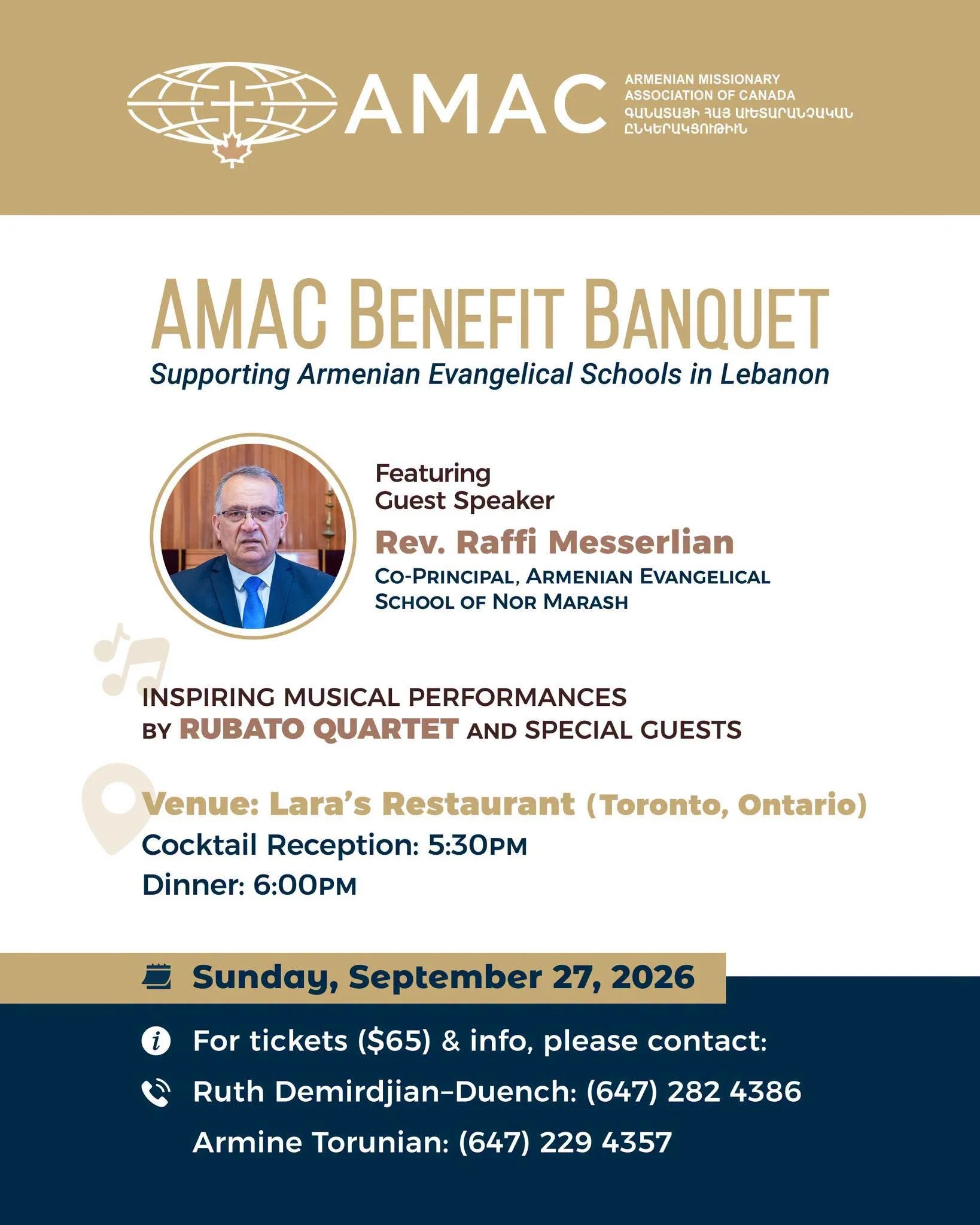
TORONTOHYE—In times of deep national crisis, a diaspora's strength is measured not just by memory, but by action. For more than four decades, the Armenian Missionary Association of Canada (AMAC) has answered that call—transforming Christian solidarity into a practical lifeline for vulnerable Armenian communities across Canada, Armenia, and the Middle East. From emergency infant nutrition and child sponsorships to school subsidies and elder care, AMAC’s mission has long stood on the front lines of humanitarian need. Today, as families in Lebanon face unprecedented socio-economic hardship, that mission takes on renewed urgency. On Sunday, September 27 at 5:30 p.m., AMAC will gather the community at Lara’s Restaurant in Toronto (155 Consumers Rd.) for a special benefit banquet dedicated to sustaining the Armenian schools and students fighting to keep learning alive in Lebanon.
Torontohye sat down with AMAC President and CEO Ruth Demirdjian Duench to discuss the heartbeat behind the event and the historic institutions relying on this vital support.
Torontohye: With Lebanon navigating profound socio-economic distress, this upcoming benefit banquet comes at a pivotal time. What is the central urgency behind organizing this event right now, and which schools and institutions will directly benefit from the community’s support?
Ruth Demirdjian Duench: The situation in Lebanon remains exceedingly difficult for families, educators, and children. Our goal with this banquet is to mobilize the Canadian-Armenian community to ensure that our vital institutions continue to function and offer stability. The funds raised will directly support Armenian schools in Lebanon serving vulnerable populations, including the Armenian Evangelical Shamlian Tatigian Secondary School in Bourj Hammoud, the Armenian Evangelical Secondary School of Anjar, and other educational programs assisting children in critical need.
Torontohye: Tell our readers about Shamlian Tatigian—its history, objectives, and services.
Ruth DD: Shamlian Tatigian has stood for over 90 years as a cornerstone of education in the Armenian community of Lebanon, building strong character, academic achievement, and lifelong service rooted in Armenian heritage and Christian values. Guided by the biblical principle, “God is love, and whoever abides in love abides in God, and God abides in them” (1 John 4:16), the institution educates generations with moral integrity.
Its history began in 1930 in the Nor Marash district of Bourj Hammoud, an area settled by Armenian survivors from Cilicia, Anatolia, following the 1915 Armenian Genocide. Officially opening in 1934 as the Nor Marash Armenian Evangelical School, it started humbly with a kindergarten and two elementary classes. The school expanded steadily over the decades: in 1936, Reverend Garabed Hassessian increased the elementary division to six classes, followed by Reverend Aram Hadidian adding further classrooms. In 1950, four intermediate grades of the second cycle were introduced, and in 1958, the three secondary grades of the third cycle were officially certified. In 1964, after Mr. and Mrs. J. Shamlian and their son Mr. G. Tatigian generously contributed a new, modern building, the institution was renamed the Armenian Evangelical Shamlian-Tatigian Secondary School.
Today, the school compound, which also encompasses the Nor Marash Armenian Evangelical Church, serves approximately 300 pupils from kindergarten through secondary school. Beyond the classroom, vibrant student life programs build teamwork, confidence, creativity, and leadership, while an active global alumni network connects graduates across continents. Thousands of students from low-income families have received an excellent education alongside hope, stability, and future opportunities. As the school’s mission statement emphasizes, it provides “education that shapes the whole person,” dedicated to cultivating cultural pride, spiritual growth, and a strong foundation for lifelong learning while forming students who pursue excellence, live with integrity, and serve their communities with love.
Torontohye: How does AMAC help Shamlian Tatigian on the ground?
Ruth DD: The school uses the funds we raise primarily to pay teacher salaries, subsidize tuition for underprivileged children, and provide essential daily nutrition. Last year, every student received sandwiches at least twice a week through this program. We are deeply grateful to the parents who volunteer to prepare and serve meals, as well as the women's auxiliary groups from local churches who faithfully support us.
The school holds a special place in my heart because I was once a student there myself. I am deeply grateful for the education and values I received, and it is a true honour to give back and help the next generation succeed.
Torontohye: Tell us about the Armenian Evangelical Secondary School of Anjar—its history, education, and unique boarding model.
Ruth DD: The story of the Anjar school is intimately tied to the historic settlement of the Armenian people of Musa Dagh, who relocated to the village of Anjar in Lebanon's Bekaa Valley in 1939. Soon after their arrival, the elementary school began operating inside the newly constructed church building. Amid severe hardships, the elementary section celebrated its first graduating class in 1947. That same year, Sister Hedwig Aienshanslin of the Swiss-German Hilfsbund Mission arrived in Anjar and initiated missionary work from a single room. In 1948, Sister Hedwig assumed the administration of the school and expanded it into a junior high school, later joined by Sister Mary Rock, Sister Anna Nitsche, and later in the 1950s by Sister Hanna Christen, who became especially beloved by the boarding students. Remarkably, all four dedicated missionaries learned the Armenian language to communicate directly with the community. By 1955, the boarding department was established with an initial cohort of 15 students from Kessab, Beirut, and Zahleh, and by 1956 the school offered full kindergarten-through-secondary cycles.
The Armenian Evangelical Secondary School of Anjar (AEBS) is the only school in the Near East diaspora that provides both residential care and comprehensive education to children ages 3 to 18, spanning kindergarten through 12th grade. Its boarding department provides a safe, nurturing home for boys and girls from various denominations facing poverty, broken family structures, neglect, trauma, or unsafe environments.
Torontohye: What specific programs and initiatives are happening at the Anjar school today?
Ruth DD: We were fortunate to learn directly from Rev. Hagop Akbasharian, the school's principal and overseer of its boarding facilities, when he visited Toronto and Montreal in September 2025. Rev. Akbasharian and his team have implemented comprehensive academic and social support pillars across the campus. These include personalized learning tracks for students with special needs, educational gaps, and refugee children, supplemented by remedial English classes and tablet technology to bridge digital divides.
The school also maintains critical scholarship funds covering tuition, room, board, and living expenses for boarders, Syrian refugee students, and gifted children with limited financial resources. Students engage in interactive and environmental initiatives such as robotics, peace education, Design for Change, WeNEEDle, Seeds of Hope, a GoGreen botany and agriculture project, a campus recycling program, and solar energy. Through the Healing Harbor initiative, vulnerable children receive psychological and social support, alongside teacher training and summer shelter for children at risk. Following Christ’s example of compassion, the school transforms hardship into positive change, and every dollar raised at our banquet directly provides these children with education, safety, counseling, and a brighter future.
Torontohye: Who will deliver the keynote address at the banquet?
Ruth DD: Our keynote speaker is Rev. Raffi Messerlian, co-principal of the Shamlian Tatigian School and pastor of the Armenian Evangelical Church of Nor Marash in Bourj Hammoud. Rev. Messerlian is a graduate of Haigazian University and the Near East School of Theology, as well as an active member of the Association of Evangelical Schools in Lebanon. He served for 18 years as pastor and school principal at the Armenian Evangelical Church and Secondary School in Anjar before assuming his pastoral leadership at Nor Marash in July 2014. Drawing from his extensive leadership in both Anjar and Bourj Hammoud, Rev. Messerlian will share firsthand insights into the realities in Lebanon, the challenges facing Armenian schools, and how these institutions continue to deliver hope against extraordinary odds.
Torontohye: How can community members purchase tickets or support the banquet?
Ruth DD: Tickets are $65 each and can be reserved by contacting me at 647-282-4386 or Armine Torunian at 647-229-4357. Those who cannot attend in person but still want to support Armenian students and schools in Lebanon are warmly invited to donate online through our website at amacnews.org. ֍
This conversation was published in Torontohye's Sept. 2026 (#229).