Eve Egoyan bridges past and present in ‘Longing and belonging’ performance at Walter Hall
Tracing a lineage from Komitas Vardapet to contemporary compositions
TORONTOHYE—On May 7, 2026, the University of Toronto’s Faculty of Music presented a solo piano recital by Eve Egoyan titled ‘Longing and belonging: Music for piano by Armenian composers’. Held at Walter Hall, the performance was the inaugural public concert of the Global Musical Modernities and Local Agency Conference. This international gathering, supported by the Jackman Humanities Institute and the Social Sciences and Humanities Research Council of Canada, brought together over 50 speakers from 17 countries to examine the boundaries of Western art music in a globalized context.
The evening was introduced by Michelle Assay, a research fellow at King’s College London and the University of Toronto, who co-organized the conference with Professor Robin Elliott. In her opening remarks, Assay emphasized the thematic weight of the recital:
“[This conference is] about connection through music. Something needed in a world so often marked by conflict, division, and hostility. Tonight’s concert speaks directly to that theme through the music of Armenian composers, but also through a deeply personal artistic journey, the journey for belonging."
The recital was curated by Egoyan following her first journey to Armenia in 2022. The program was designed to trace the evolution of the Armenian "national idiom," a concept first championed by Komitas Vardapet (1869–1935).
The performance opened with Tigran Mansurian’s Lullaby for the Knight (2010), a spare, meditative work dedicated to the late Russian composer Andrey Volkonsky. This was followed by Mary Kouyoumdjian’s ‘Aghavni’ (Doves) (2009), a piece that blends lyrical stillness with the tension of family histories shaped by the Lebanese Civil War and the Armenian Genocide.
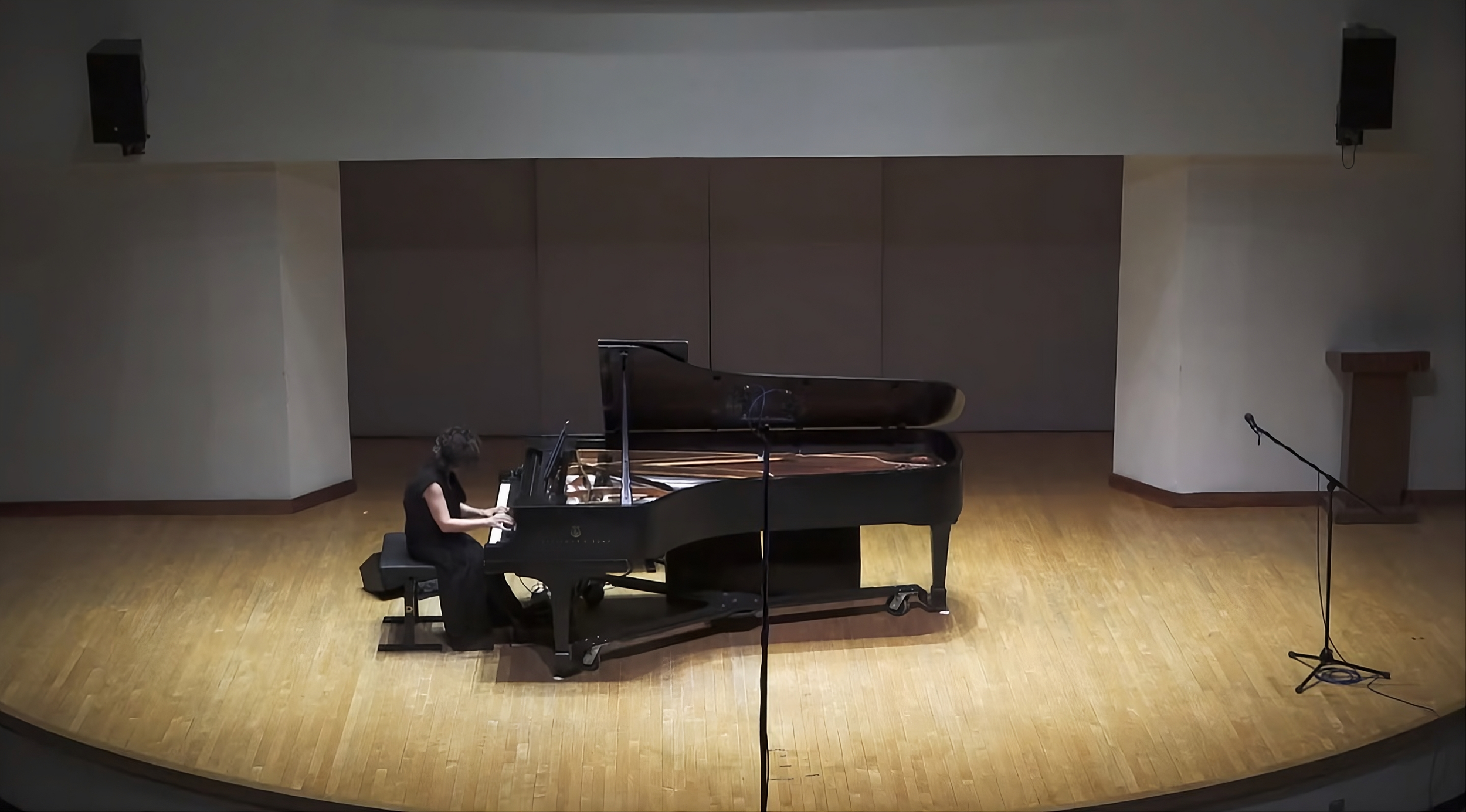
Video: Faculty of Music, University of Toronto YouTube channel
The technical complexity increased with Boghos Gelalian’s ‘Tre Cicli’ (1969). Gelalian, a Lebanese-Armenian composer born in Alexandretta, utilized dense chromatic textures and driving rhythms to bridge the gap between Middle Eastern modes and Western musical modernism. Following this, Egoyan performed excerpts from Vache Sharafyan’s ‘Goat-Rite’ (2014), a ritualistic 12-movement cycle that utilizes incantatory repetition and resonant silence to evoke a pre-modern ceremonial world.
While the recital marked a professional milestone, Egoyan’s engagement with Armenian repertoire is a relatively recent development. In a 2024 interview with Dr. Araxie Altounian for her Torontohye/@AGBU Toronto series ‘Musical minds’, Egoyan spoke about why she had historically avoided this music. Her parents, visual artists who emigrated from Egypt in 1962, raised her in a household where art was paramount, but Armenian music carried a heavy psychological burden. Her father’s parents were both orphans of the Armenian Genocide.
"Armenian music was a complicated issue for me," Egoyan said in the 2024 interview. "My father responded very emotionally to it... it was pretty unbearable how easily triggered he was to this music. Since I couldn’t deal with his emotional response... I avoided it."
She further noted that throughout her career as a contemporary music specialist, she preferred music that was "new" to her ears because it offered a "cleaner journey." She explained, "When you have a history of hearing something, it’s harder to hear it for the first time and find a true place for yourself within it."
The second half of the program centred on Komitas Vardapet’s ‘Seven Dances for Piano’ (1906). These works—including ‘Manushaki,’ ‘Yerangi,’ and ‘Shoror’—are pivotal in the Armenian canon for their unconventional treatment of the piano. Rather than using thick European harmonies, Komitas opted for a minimalist, transparent texture that imitates traditional folk instruments and drones.
Following Nariné Khachatryan’s ‘4 Monodien für Klavier’ (2011), the evening concluded with Egoyan’s own composition, Ghosts beneath my Fingertips (for Viva) (2020). Written for an augmented acoustic piano, the work layers live performance with electronic extensions and the recorded voice of Egoyan’s daughter, Viva. The piece uses fragments of Armenian folk material to explore the space between "presence and absence, novelty and lineage."
Following the music, musicologist Dr. Araxie Altounian provided a historical presentation. She explained that Komitas’s work to establish an Armenian national school was tragically cut short in April 1915 when he was arrested along with hundreds of Armenian intellectuals. This event, which marked the beginning of the genocide, left Komitas permanently traumatized; he spent the final 20 years of his life in psychiatric hospitals, leaving much of his work unfinished.
Altounian noted that the subsequent diaspora created a "cultural passport" out of music. In the absence of a material connection to the lost homeland, each generation of musicians adapted to their new environments—Lebanon, Germany, America, and Canada—creating a diverse range of styles.
Altounian concluded the evening by thanking the organizers and framing the recital as a testament to cultural vitality: "...[W]e are all richer through diversity. This conference is a testament and a celebration of that diversity.” ֍
***
This article was published in Torontohye's June 2026 issue (#226).
Video capture: Faculty of Music, University of Toronto YouTube channel.