When faith comes home: A personal reflection
His Holiness Aram I leads Tyndale University’s commemoration of the 1700th anniversary of the Council of Nicaea with a keynote address
On Monday, October 20, 2025, Tyndale University, in partnership with the Armenian Prelacy of Canada, hosted a historic event commemorating the 1700th anniversary of the Council of Nicaea. The evening brought together clergy, scholars, students, and faithful from diverse Christian traditions for an ecumenical prayer service, theological reflection, and dialogue on the enduring legacy of the Council and its impact on Christian faith and unity.
The Council of Nicaea, convened in 325 AD by Emperor Constantine, was the first ecumenical council of the Christian Church and a defining moment in the articulation of Christian doctrine. It affirmed the divinity of Christ and produced the original Nicene Creed, establishing a foundation for orthodox Trinitarian theology that continues to unite Christians across centuries. The Armenian Church holds the Council of Nicaea in profound esteem, recognizing it as a cornerstone of the universal faith to which the Armenian Apostolic Church has remained steadfastly committed. Notably, Aristakes, the son of St. Gregory the Illuminator, the first Catholicos and founder of the Armenian Church, was among the 318 bishops who attended the Council, bearing witness to Armenia’s early and active participation in the life and unity of the global Christian Church.
His Holiness Aram I, Catholicos of the Holy See of Cilicia, presided over the commemoration and delivered the keynote address. He was accompanied in procession by Archbishop Papken Tcharian, Prelate of the Armenian Prelacy of Canada; Archbishop Anoushavan Tanielian, Prelate of the Eastern United States; His Grace Bishop Boulos of the Coptic Orthodox Church of Mississauga and Western Canada; Bishop Robert Saeed Jarjis of the Chaldean Catholic Eparchy of Mar Addai in Canada; Archimandrite Makarios Wehbi of the Melkite Greek Catholic Eparchy in Canada; and Reverend Father Petre Busuioc of the Romanian Orthodox Diocese of Canada. Right Rev. Fr. Keghart Kosbakian, Right. Rev. Fr. Karekin Shekherdemian, Very Rev. Fr. Hagop Yacoubian, Very Rev. Fr. Sarkis Libarian, and Rev. Fr. Nshan Manougian also represented the Cilician Armenian delegation. Pastor Zohrab Sarkissian and Pastor Ara Balkjian were also in attendance, representing the Armenian Evangelical Church.
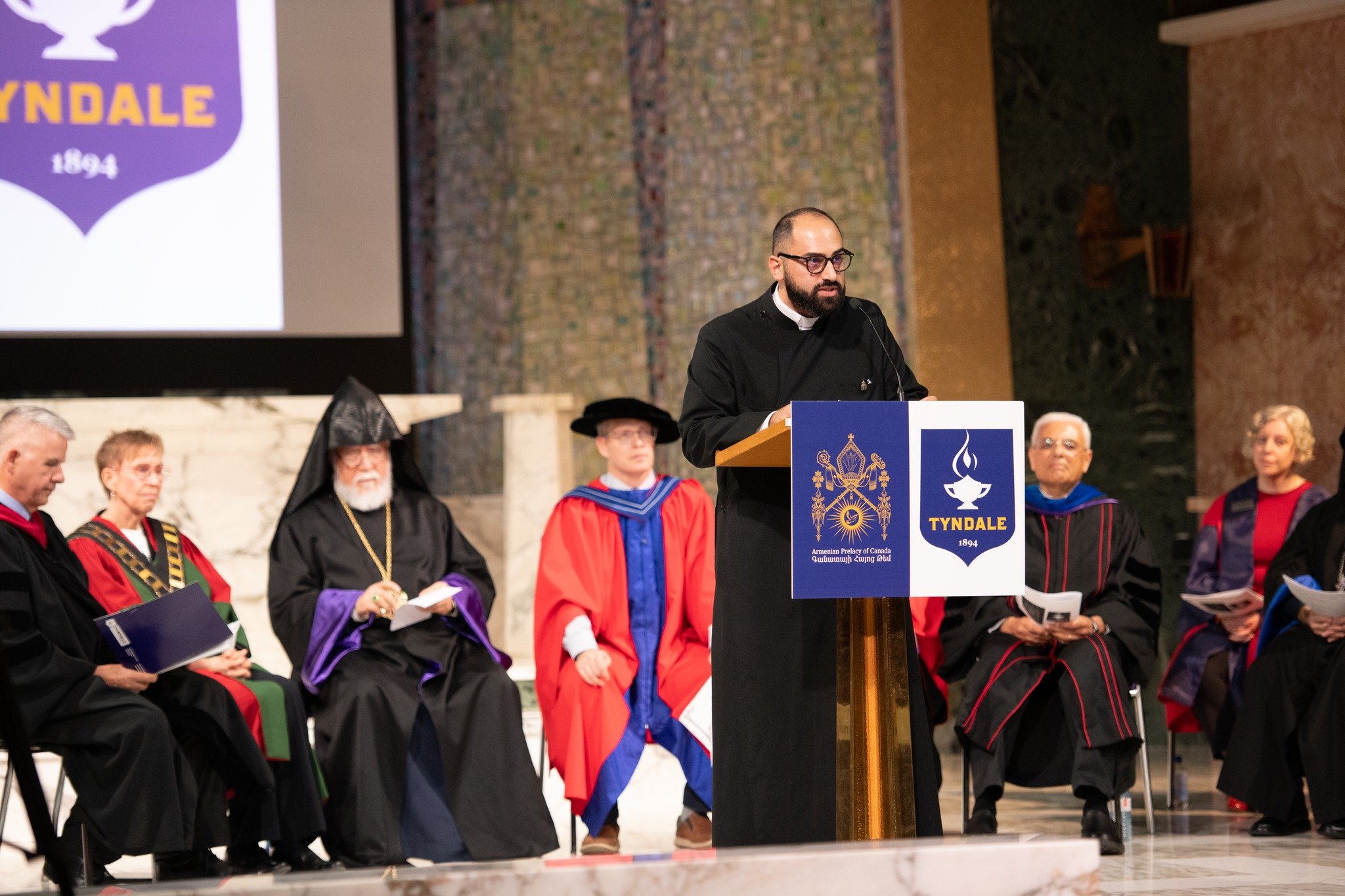
Photo: Ishkhan Ghazarian
Representing Tyndale University were President and Vice Chancellor Dr. Marjory Kerr, Provost and Chief Academic Officer Dr. Beth Green, Academic Dean of Seminary and Graduate Studies Dr. Michael Krause, Professor of Global Christianity Dr. Wafik Wahba, Associate Professor of Christian History Dr. Ashoor Yousif, and Professor of Theology Dr. James Pedlar. The evening also featured a theological dialogue between His Holiness Aram I and Tyndale faculty, including Dr. Wahba, Dr. Yousif, and Dr. Pedlar. Dr. Pedlar will serve as the professor of record for the upcoming Armenian Apostolic Church History course launching at Tyndale next year.
The evening opened with words from Dr. Michael Krause, who reflected, “In the spirit of the Nicene Creed, our presence here itself is an ecumenical, religious, and spiritual event. Tyndale University considers itself an ecumenical community.” He then invited Dr. Marjory Kerr, who offered a warm and heartfelt welcome on behalf of the university.
It was my personal honor to introduce the keynote speaker, His Holiness Aram I, Catholicos of the Holy See of Cilicia, who delivered an inspiring address on the theological and historical significance of the Council of Nicaea. His Holiness emphasized the Council’s enduring influence on Christian unity and doctrine, calling the audience to continue the work of reconciliation and shared witness among the churches.
Following the keynote, Dr. Krause moderated a panel discussion as the panelists explored the lasting implications of the Nicene Council’s decisions and their relevance for contemporary theology and the global Church. The dialogue highlighted how the Nicene faith continues to shape the Church’s witness across traditions and generations.
For me, the evening carried a deep personal resonance. My own journey in theology began in the hills of Bikfaya, Lebanon, where I spent the summer of 2017 immersed in the rhythm of prayer, study, and service at the Armenian Theological Seminary of the Holy See of Cilicia. It was there that I first encountered the living tradition of the Armenian Apostolic Church not as an abstract institution, but as a vibrant spiritual home.
In 2018, while discerning where to pursue further studies, I attended an open house at Tyndale University. The atmosphere of ecumenical openness and academic rigor immediately drew me in. Here was a place where faith and intellect intertwined and where I could explore theology not only from an Armenian perspective but also in conversation with the wider Christian world.
In early 2020, I returned to Armenia for eight and a half months of volunteer service, which was a transformative period marked by teaching, outreach, and deep engagement with local communities. When the Artsakh War erupted that September, the experience underscored the urgency of faith as a source of resilience and hope amid suffering.
Returning to Canada, I began my Master of Theological Studies at Tyndale while working at the ARS Armenian Private School between 2021 and 2023. Balancing ministry and academics grounded my theological formation in the lived experience of faith within the Armenian community. I carried the ethos of Antelias and the roots of my Church and homeland through each course I took, each paper I wrote.
Now, witnessing His Holiness Aram I’s visit to Tyndale felt like a convergence of these journeys with faith, service, and education woven together. It was as though for a few brief hours, Tyndale transformed into Antelias, and my two worlds converged. His Holiness’ lifelong commitment to ecumenism and Christian education mirrors the very values that define Tyndale’s mission. The visit of His Holiness is not merely an institutional milestone; it feels like a spiritual homecoming: a moment to recognize how the seeds planted in places like Bikfaya, nurtured through study at Tyndale, and tested through service in Armenia, continue to bear fruit. It was a marvelous sight to see the Cilcian Brotherhood with their veghars (cowls) in the very chapel that I had graduated from nearly a year and a half ago.
It was also incredibly touching to be with my former classmate, Zohrab Sarkissian, now the pastor of the Armenian Evangelical Church in Toronto, as we processed with the delegation into the chapel and participated together from the altar in the ecumenical prayer service. In that moment, the unity and diversity of the Body of Christ were made beautifully visible. It was a living reflection of the Nicene faith that we came together to celebrate.
At the conclusion of the ecumenical prayer service, the Toronto St. Mary Zareh Aznavorian Choir, led by Anush Galstyan, sang the Nicene Creed in Classical Armenian. It was a profoundly moving spiritual moment to hear the language of my ancestors echo throughout the Tyndale Chapel.
The ensuing ecumenical dialogue fostered a distinguished exchange of ideas and underscored the importance of Christian unity and togetherness amidst today’s globalized world. His Holiness and the professors on the panel touched on various theological, socio-economic, political, and anthropological issues. The elevated discourse was a delight to listen to, and attendees were left wanting to hear more.
Following the event, a period of fellowship took place in the university’s alumni hall. You could feel the energy and enthusiasm that the evening had inspired in the air as colleagues, professors, clergy, and attendees interacted with one another.
It was a truly remarkable evening, one that you could tell filled members of Toronto's Armenian community with great joy and spiritual fulfillment. ֎
This piece was published in Torontohye's Nov. 2025 (#219) issue.