Finding Victoria Rowe: A guide to finding former researchers of Armenian studies
Dr. Victoria Rowe is a PhD graduate from the University of Toronto. Her dissertation, entitled “The ‘New Armenian Woman:’ Armenian Women’s Writing in the Ottoman Empire, 1880-1915,” was published in 2000 and is still available online via the University of Toronto’s (UofT) virtual TSpace library. More than 20 years later, while I was a high school student experiencing the fresh high of getting into university, I read the dissertation.
I had skimmed a number of PhD theses on Armenian issues before I came across Rowe’s, but none stood out in the same way hers did. Rowe wrote about female Armenian intellectuals of the late 19th and early 20th century. These were inspirational women who faced Ottoman and Soviet oppression and whose lived experience was at an intersection of ethnicity, gender, and class rarely centered in historical discussion. The dissertation wasn’t a dense, incomprehensible academic text so much as a storybook that illuminated potential role models for young Armenian women.
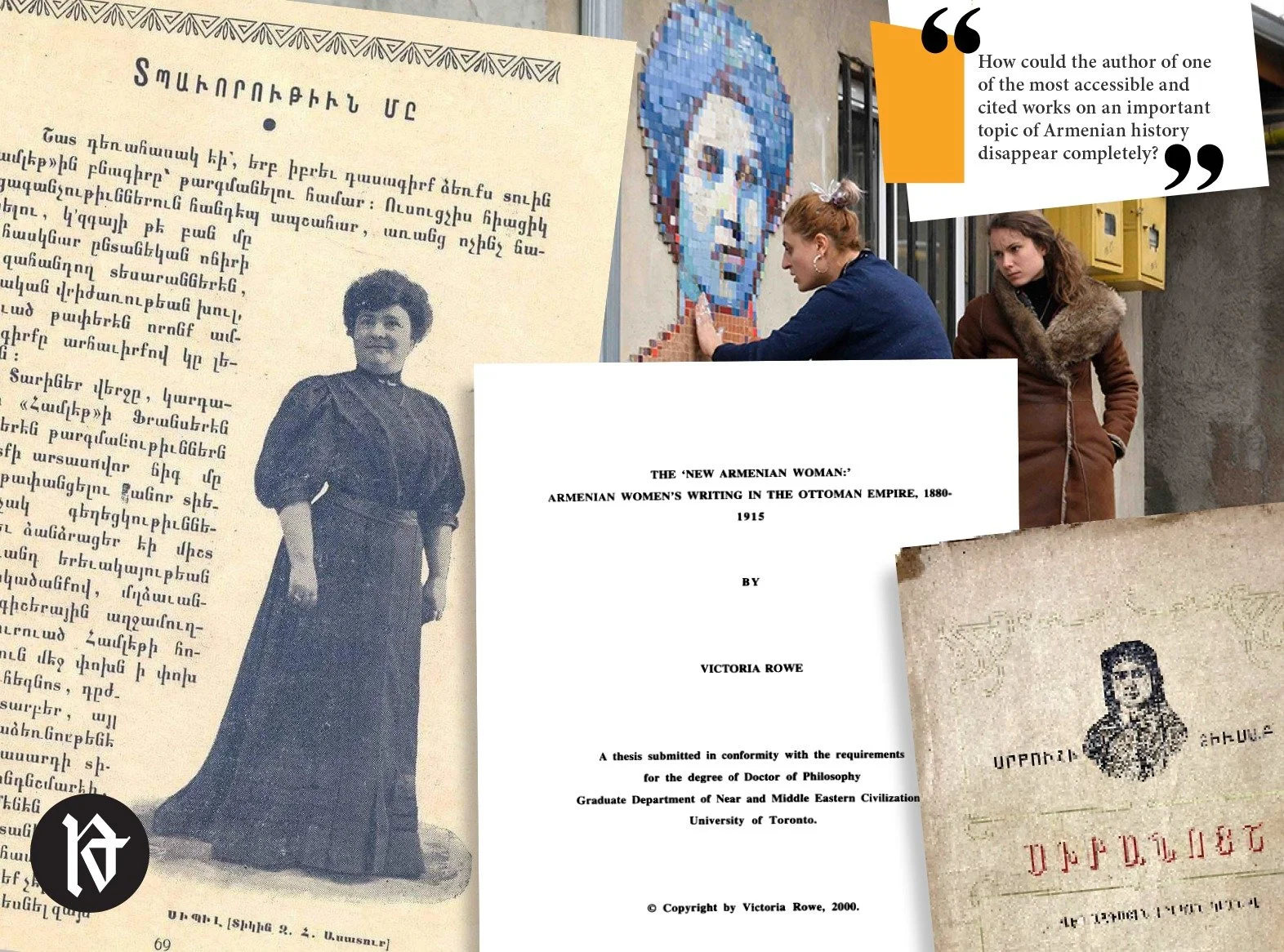
Background photo: Artist Siranush Aghajanyan creates a mosaic in Yerevan to honour novelist Zabel Yesayan on Feb. 4, 2021, on what would have been her 143rd birthday (Photo: Hugo Hanne/Civilnet)
I’d be lying if I didn’t acknowledge that Rowe’s non-Armenian name also piqued my interest. Was she an Armenian with mixed heritage, or a non-Armenian somehow interested in Armenian studies? All the other dissertations I scanned had noticeably Armenian authors with last names ending in -ian or -yan. Searching up the names of the other academics brought up more information bolstering their obvious Armenian identities. But Googling Rowe’s name brought up nothing substantial. I couldn’t find what she was up to now, if she was still in academia lecturing at another university. I couldn’t find a Facebook, Twitter, or LinkedIn profile to message my thanks to, as I’d done with other writers. In fact, there was hardly any information about her readily available online besides the fact that she had published a dissertation on Armenian women’s writing.
I found it weird that Rowe wasn’t traceable, considering how frequently her work is cited in English-language discussions about Armenian women writers. To emphasize how critical her work in compiling information about Armenian women writers is, consider this: Half the sources listed at the bottom of the English Wikipedia article on Zabel Yessayan were authored by Rowe. For Srpuhi Dussap’s English Wikipedia page, a fifth of the references are from Rowe’s work. How could the author of one of the most accessible and cited works on an important topic of Armenian history disappear completely?
After a few intense Googling sessions, mixing and matching various keywords (Victoria Rowe University of Toronto, Victoria Rowe Armenian women, etc.), I was prepared to let it go. Maybe Victoria Rowe got married and changed her name soon after completing her PhD studies. Maybe she moved from Toronto to a remote island without internet access. Maybe she didn’t want to be found at all.
An experience I had at an Armenian community event a few months later re-ignited my desire to keep searching. I was at the Armenian Relief Society’s (ARS) annual International Women’s Day event, where the keynote speaker was Arpi Krikorian, the founder of Arpi Publishing, a non-profit Western Armenian publishing house. She gave a very engaging address, both sharing her personal story of persevering to succeed as an artist and also making the broader case for the need to support Armenian writing. During her talk, to make a point about how little Armenians know about their own writers, she asked the crowd to name one female Armenian writer. The vast majority of the crowd struggled while I turned to my mom and simply listed off the women Rowe covered in her dissertation: Zabel Yessayan, Srpuhi Dussap, and Sibyl. I felt at that moment that since Victoria Rowe had helped me access a deeper understanding of my heritage that was clearly not as easily accessible to the broader community, I owed it to her to find her and say thank you.
So my search began anew, and I decided to start with the place Rowe and I had in common: UofT, where I am an undergraduate engineering student. UofT’s websites didn’t have much about Rowe; the only information I already knew was that she had graduated with a PhD from the Department of Near and Middle Eastern Civilizations (NMC) in the year 2000. UofT is a big school with a sprawling campus, meaning I had never been in the building that housed the NMC, let alone met someone who actually works there. I decided to just call the number listed on their website from the comfort of the Bahen building instead of trekking to a foreign corner of campus.
The polite receptionist who answered my call did not have much information to offer on Rowe. She did offer me a lead, though: The NMC website listed Rowe’s PhD supervisor, Dr. Rivanne Sandler, a now-retired researcher at the NMC with minimal online presence, whom I assumed was a dead end. The receptionist informed me that I was actually in luck. While Professor Sandler was indeed retired, she was actually back on campus for that semester, teaching. The receptionist gave me Sandler's e-mail address and reassured me that this professor responded to e-mails in a timely manner. So, I typed up a quick email to Sandler summarizing my query: I am an Armenian student at UofT who likes Victoria Rowe’s thesis, and I would like to connect with her if possible.
Within seven hours, I had a response. Sandler was happy that someone was interested in Rowe’s doctoral thesis and willing to try to find her, even though she was not in contact with Rowe and had not been for years. Not to be a complete dead-end, she offered a potential lead: There was another person who had met Victoria Rowe in the flesh and could potentially have her contact. There was an outside examiner at Rowe’s PhD defence who was impressed by the thesis and offered good commentary on it. Even though Sandler didn’t remember much about him, maybe the NMC had records on the PhD defences. Maybe through them, I could find this guy and then find Rowe.
Since Sandler had praised the dissertation as highly original work and bolstered my morale to search for Victoria Rowe, I confidently called the NMC a second time. It was only during my call that the ridiculousness of my request became apparent: I wanted the contact of a guy who I don’t know the name of nor which academic institution he was affiliated with—all I knew was that he was at this one PhD defence, more than 20 years ago. The receptionist gently let me down—the NMC did not keep records of PhD defences from more than 20 years ago. There was no way of finding this outside examiner through them. There were no more leads at the NMC to follow.
Disappointed, I ended up in my dorm room Googling Victoria Rowe’s name again. On the fourth or fifth page of Google results, there was one of the most recent web pages mentioning Victoria Rowe: a Horizon Weekly article from 2013 about a book being published on the Armenians of Khodorchur. Rowe was listed as one of the book's editors, alongside a half-dozen other contributors. I was able to find the person who wrote the foreword, Hovann Simonian on LinkedIn. So I cold-messaged him at 2:31 a.m. on a Tuesday, asking him to confirm that he wrote the forward of the book. Surprisingly, he messaged me back, and I got to repeat my inquiry to another stranger: I am searching for Victoria Rowe, who edited the book you wrote the forward to. I am an Armenian woman looking for a woman who wrote about Armenian women writers (I was going slightly crazy at that point). He promised to try to find her contact information for me.
In the same week as my exchanges with Simonian, I attended another ARS event where the keynote speaker was Dr. Khatchig Mouradian an accomplished professor at Columbia University and the Armenian and Georgian Area Specialist in the African and Middle Eastern Division at the Library of Congress. After the event concluded, I rushed to Mouradian to not only thank him for delivering a thought-provoking address, but also to ask if he had any leads on Victoria Rowe. While he said her name and research were familiar, he didn’t know how to get in touch with her either–but he did encourage my search as a worthwhile and meaningful one. He gave me his card, wished me well, and told me to reach out with any updates.
At this point, I had about a dozen people invested in my search for Rowe and the story behind her research more broadly. So when Simonian messaged me a few e-mail addresses to try, I felt a deep responsibility to reach out to Rowe in a way that was respectful of her privacy but also yielded answers to the many questions that had sprung up along the way.
My initial e-mail was sent to all the potential e-mail addresses and was brief. I repeated my initial desire to be in contact with the author of a dissertation I liked and summarized how I came to have access to these e-mail addresses. To my surprise, two days later, Victoria wrote back.
First off, she congratulated me on finding her. She confirmed my assumptions that she was no longer in academia, no longer based in Toronto, and not active on social media. Best of all, she told me I could e-mail her any questions I had.
So when I wrote back, I explained the impact of her work and asked if I could ask her questions for a Torontohye article instead of just personally. I am so fortunate that she agreed to be interviewed so that I can present the long-awaited story behind the dissertation in an upcoming issue of Torontohye.
So when I wrote back, I explained the impact of her work and asked if I could ask her questions for a Torontohye article instead of just personally. I am so fortunate that she agreed to be interviewed so that I can present the long-awaited story behind the dissertation in the next issue of Torontohye.
For now, I would like to reflect a bit: What are the ‘lessons learned’ from this search? I would say a big one is that we need to support and publicize research on Armenian studies as it is happening—while the academics are still involved in academia, easily reachable via their university e-mails, and in a position to professionally benefit from being platformed in interviews. Finding Victoria Rowe two decades after her dissertation was published was not an easy feat, and I am very fortunate she chose to take the time to tell me about a chapter in her life she had largely moved on from. I imagine that if someone interviewed her in 2000 when the research was freshly done, they would’ve gotten better insights into her process and methods. Likely, they would’ve been able to connect with the supporting cast and gain their perspectives on her work–connecting with colleagues at the NMC who were actually familiar with her research, the examiners at her PhD defence, and the Armenians who helped Rowe along the way.
Another takeaway is that while finding former researchers can prove to be challenging, it is a small, supportive Armenian world. Armenian newspapers are great resources (I wouldn't have known to connect with Hovann Simonian had it not been for the Horizon Weekly article). So are community events where Armenian leaders can inspire and connect with youth.
Adding on to that takeaway, I think it’s important to emphasize the level of support and kindness there is for young Armenians interested in Armenian studies. I wanted to find Rowe out of pure personal curiosity—as some people repeatedly reminded me, Armenian women’s writing has nothing to do with my degree. However, at every stage of the search, I was met with support, even from strangers who had nothing to gain from helping me. I was asked if I wanted to get involved in research in Armenian studies and about my personal connections to Armenian topics; I was encouraged to keep pursuing what I was interested in. I am so grateful, and I hope that young Armenians who are in the humanities and social sciences are encouraged to be persistent and pursue opportunities in the areas of Armenian studies that inspire them. ֎
This article was published in Torontohye’s Dec. 2024 (#208) issue.