What’s the return on investment for learning Armenian?
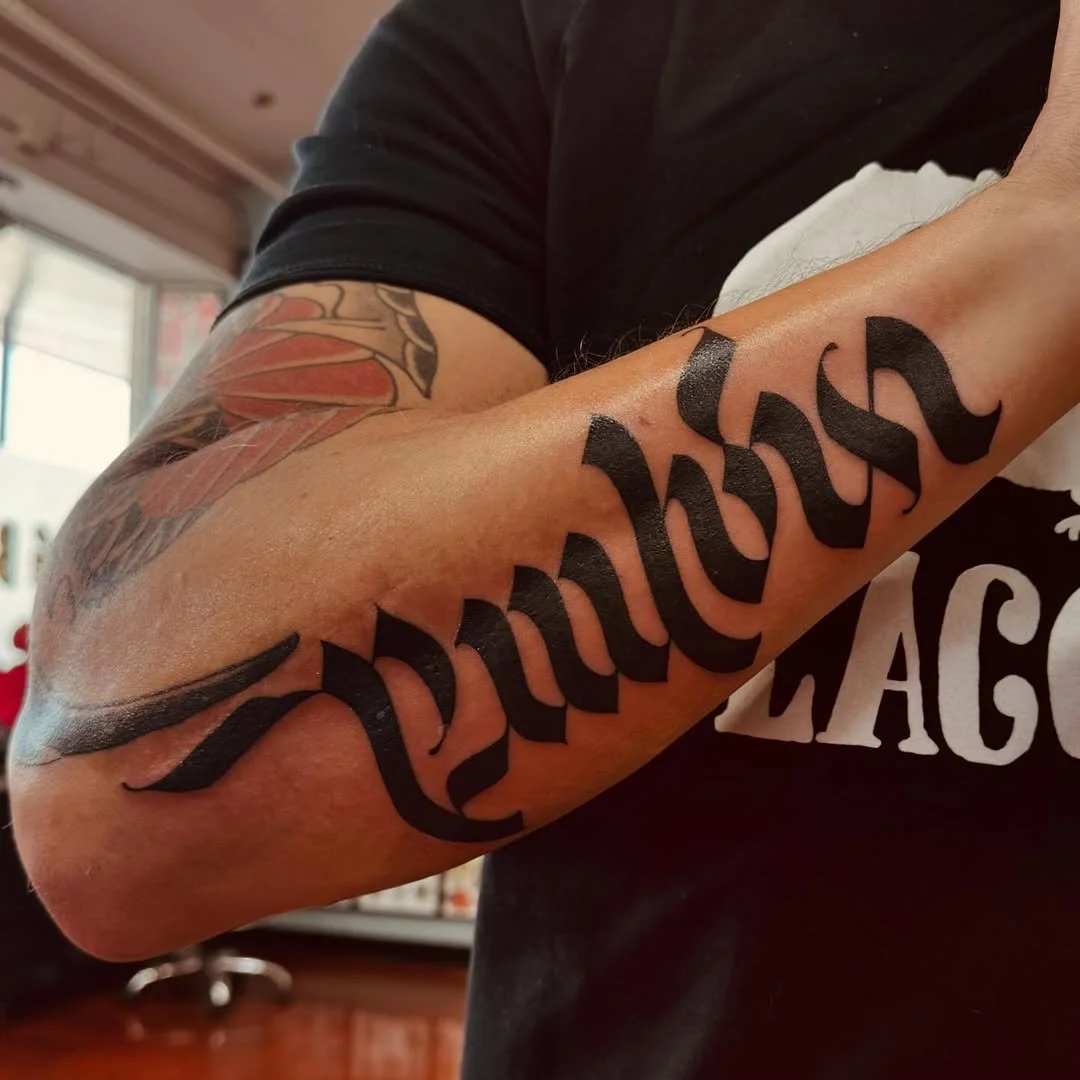
Armenian American actor Joe Manganiello displays a his tattoo which reads բախտ (‘chance’) in Armenian. Script: Ruben Malayan, Tattoo: Francesca Tattoo, Photo: @joemanganiello/Instagram.
I can summarize contemporary discourse on learning and preserving Armenian in the diaspora into two camps. The first is a traditional, conservative view that treats Armenian language acquisition as a moral obligation for all diasporans (an approach that, in its pursuit of linguistic purity, often results in exclusion). The second is a more contemporary perspective that acknowledges uneven access to Armenian education, accepts this reality as fixed, and, in an effort to resist full assimilation, adopts the reassuring mantra that “all Armenians are valid,” regardless of language proficiency (an approach that prioritizes inclusion at the risk of cultural dilution).
This piece is not about the collective relationship the Armenian diaspora has with language preservation. I want to focus on individual choice—specifically, the decision to preserve or acquire Armenian fluency in adulthood.
Many people did not choose to acquire Armenian fluency as children. Their parents spoke Armenian at home; they attended Armenian schools; they had access to community events and extracurriculars; and some even spent summers in Armenia in full-immersion environments. Many in Toronto, though born in North America—where heritage languages traditionally go to die—benefited from a combination of factors that left them at least conversational. But adulthood introduces a choice. Language is use-it-or-lose-it: Do they preserve or improve their fluency, or not?
There are also those who did not grow up with the language at all, again due to familial or geographic circumstances. They may consider learning Armenian later in life, often sparked by a specific motivation. Is it worth it, all things considered?
It is intellectually dishonest to pretend people are not making this choice, whether consciously or passively. Yet the two dominant frameworks leave little room for individual agency. The conservative view assumes there is no choice: Armenian is an obligation. The inclusive view assumes ability is fixed, that non-speakers must simply be accepted as they are, with no expectation that they might be encouraged to learn.
Right now, many young adults are deciding what role Armenian will play in their daily lives. It’s only fair to examine what goes into that decision.
How much Armenian do I need to know for it to be 'worth it'?
If you’re looking to learn Armenian for sentimental reasons—I want to speak the language my ancestors did!—this section is not for you. But I think that, for many people, sentimentality is not enough. There needs to be a practical reason to justify investing time and resources into learning Armenian.
So, in practical terms, what is the minimal effort required to get a meaningful return? How much Armenian do you need to know for it to be ‘worth it’?
Basic conversational phrases and scenarios, such as how to introduce yourself, order a coffee, and so on, are easier to learn than you think. Google Translate and Large Language Models (LLMs) handle basic phrases well, travel blogs offer listicles of keywords, and short stays in the homeland provide daily practice. You do not need to be particularly resourceful to learn these basics. But are they worth it?
You need to walk before you run. For many people, their use cases for Armenian never progress beyond basic conversation, and it is enough for them to know these scripts to feel included or integrated, or whatever it is they are seeking among Armenians.
Here is what I have come to realize, though. Most of these interactions can happen in English. Even in Yerevan, it is hard to find a restaurant without an English menu or someone my age who cannot hold a basic conversation in English. So in practical terms, basic Armenian does not expand your communicative range very much—low effort, low return.
This is not an argument against learning Armenian, nor is it a claim that anything short of full fluency, with PhD-level vocabulary, is pointless. It is an invitation to think concretely about where Armenian knowledge will actually be meaningful, and to align learning goals with those contexts. The question is not how much Armenian to learn, but for what purposes.
Do I understand what I can access in Armenian (and what I can’t)?
The sad reality is that you usually don’t realize where Armenian would be useful until you’re in the moment, woefully unprepared. I had that experience at a tech event in Armenia. I was comfortably socializing in Armenian until someone asked what university courses I take in Canada. I froze. I’d never translated my coursework. I had no idea how to say FPGA (Field-Programmable Gate Array), digital logic, renewable energy, three-phase circuits, differential equations, or printed circuit boards in Armenian. My academic life exists entirely in the anglophone world, and I couldn’t describe what I studied without sounding clueless.
The foundational textbook I (and an estimated 75 percent of engineering students worldwide who study microelectronic circuits) have used was originally written in English by professors at the University of Toronto. It has since been translated into 10 languages, but Armenian is not one of them. It’s hard to motivate speakers of a global language to learn a minority language when the global language seems to contain more information. The need to translate into the minority language comes up only in edge cases, moments when you have to extract knowledge from its dominant context.
So what is most convenient to access and express in Armenian? Things about Armenians and Armenia.
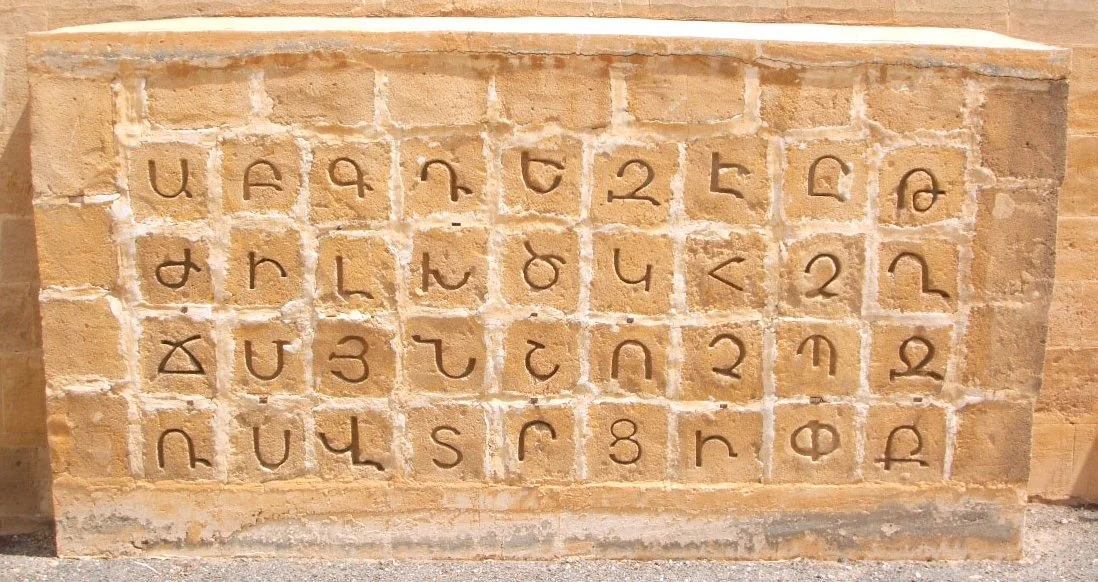
The Armenian alphabet monument at the now-shuttered Melkonian Educational Institute in Nicosia, Cyprus. Photo: Alexander-Michael Hadjilyra
Basic daily life in Armenia is easy to navigate in English, but more complex financial, legal, business, and political matters require advanced fluency. I felt this recently when I tried (and failed) to read a bond prospectus for a real estate development in Yerevan. My everyday Armenian and reliance on translation tools were inadequate for evaluating investment risk.
Over time, more of this material may become accessible in English as Armenia attracts foreign investors and expats. I could also hire translators (my 2024 lease agreement was written in both Armenian and English). But to engage fully with the modern Armenian state as it currently functions, advanced proficiency in the official language is invaluable.
You also do not need to live in Armenia to benefit from accessing Armenian-language information. Armenian-language media, written for an internal audience, offer more nuanced and culturally literate perspectives than English-language cultural products, which often flatten complexity for outsiders.
In short, it is useful to discuss your field in Armenian. It is useful to navigate business and intellectual life in the homeland. It is useful to consume cultural production in its native context. All require specialized vocabulary.
A global language gives you access to a vast world of information. Armenian gives you independent access to Armenia and the broader Armenian world.
Am I in a position to access Armenian education 'on autopilot'?
Once you realize you need an expanded, specialized vocabulary, you have to learn it. But no one is reading a translation dictionary cover to cover. Formal classes, books, and apps are useful in the early stages. Long term, though, most vocabulary comes from consuming Armenian media and attending community events.
I think many people overestimate how much Armenian they comprehend while underprioritizing media consumption. If you are never in situations where you do not fully understand what is being said, you will stop acquiring new vocabulary.
Can you watch a short video in Armenian and follow it with English subtitles? What about with an auto-translated description? Armenian subtitles, clear enunciation, visual cues, or a more fluent 'discussion buddy' to confirm your understanding—these are all crutches that make in-context learning through media consumption possible.
On the subject of learning contexts, I want to acknowledge the Armenian community here in Toronto for providing in-person spaces where language acquisition happens naturally. The Armenian Relief Society (ARS) Roubina chapter, in particular, has been a meaningful environment for me in recent years. It’s an environment where you absorb vocabulary incidentally through routine activities like event budgeting, logistics planning, and mental health seminars, with Armenian used functionally throughout.
The reality of how people acquire and maintain Armenian fluency also makes the choice of dialect far less critical than it often seems. The two standard dialects are mutually intelligible. In practice, the media you consume, the events you attend, and the people you interact with will shape the flavour of Armenian you speak. Most figurative language and vocabulary quirks are acquired on autopilot anyway.
Do I have the confidence and humility to speak Armenian?
Speaking a second language requires both confidence and humility. You need confidence to try, but also humility to accept that you will make mistakes and may sound ‘dumber’. It takes a mindset shift to become comfortable with vulnerability.
Community support is crucial. When I interned in Armenia, my coworkers at the Matenadaran, the coordinator at the Armenian Assembly of America, and the general public were patient and encouraging, which helped me improve. One memorable encounter was with an Artsakh rights advocate. I explained that I had written an article in English about ‘Learn for Artsakh’ and wasn’t sure I could discuss it properly in Armenian. She encouraged me to try and offered to teach me any words I didn’t know. Having a safe person to interact with made all the difference.
In contrast, some diasporan-led spaces can be less welcoming. I’ve seen people stress the importance of preserving Western Armenian while simultaneously harassing beginners for speaking it ‘wrong.’ You cannot expect new learners to engage if minor mistakes are met with judgment. The presence of linguistic purists may even subtly shape dialect preferences for new learners.
Finding safe, supportive people to practice with is essential for any learner.
Is there a conclusion to this overanalysis?
There is some truth to the idea that ‘Armenian speaking’ and ‘non-Armenian speaking’ Armenians are distinct categories with unique experiences, and most people cannot be converted. Most do not choose whether to acquire Armenian as children, the stage when language learning is easiest.
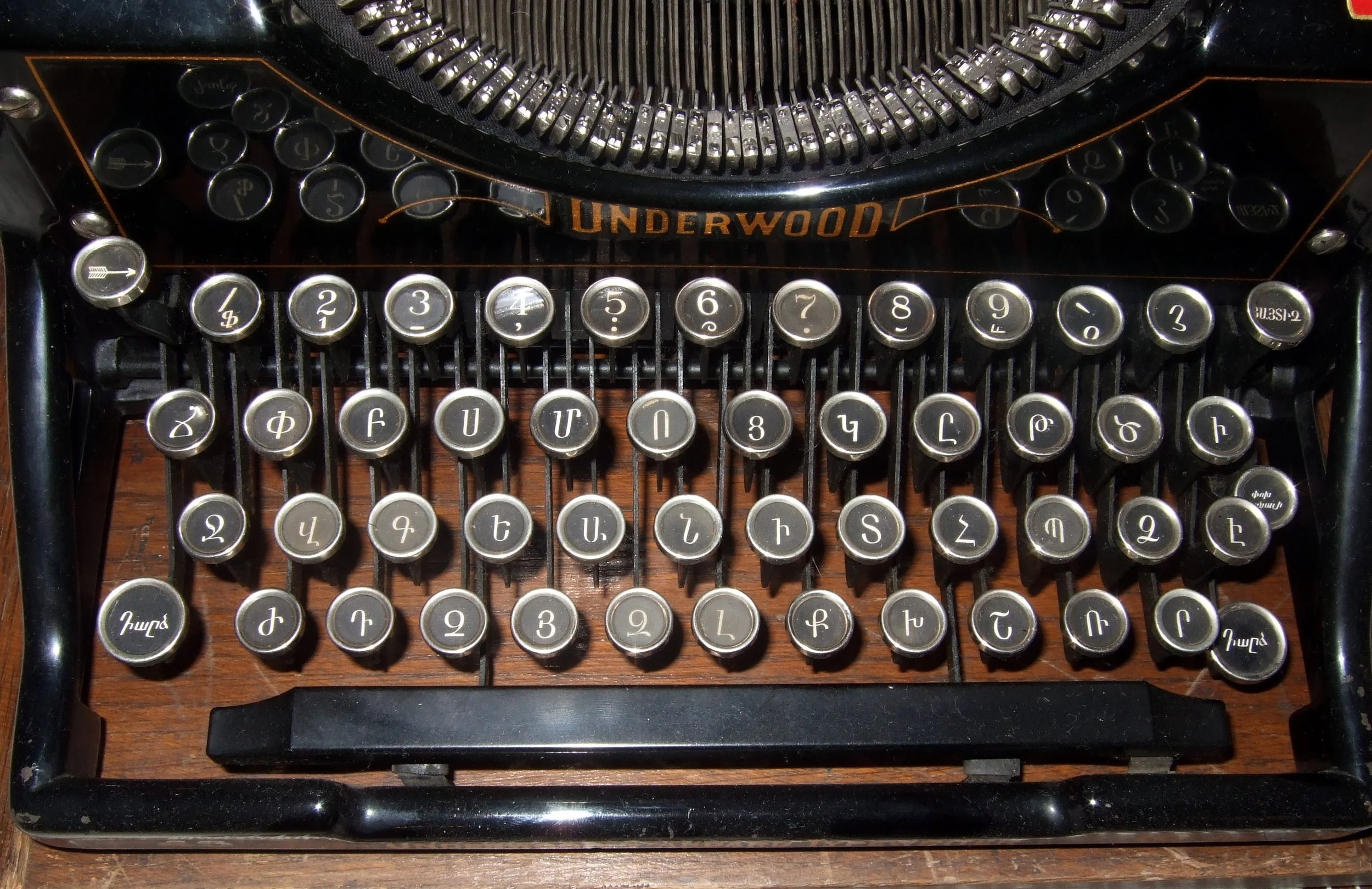
An early 20th century Underwood typewriter with converted Armenian keyboard. Photo: Chaojoker
One takeaway is to support accessible Armenian education for children, especially those who cannot speak it fully at home. Even learning to form basic sentences and hold everyday conversations gives a strong foundation for future fluency.
Because learning a language you rarely use as an adult is difficult, it is unfair to expect Armenian knowledge as a prerequisite for participating in community life. People should feel welcome as they are.
At the same time, being well-versed in Armenian and committing to continuous learning provides unique access to Armenia and the Armenian-speaking world without relying on translators. It allows a more direct, personal engagement with Armenian culture. This is why I encourage Armenian language acquisition overall.
To end on a hopeful example: Monte Melkonian, the Armenian-American revolutionary buried in Yerablur, only became fluent in Armenian as an adult. He had grown up in California and spoke English, Spanish, French, and Japanese before learning Armenian. It is never too late. ֎
This article was published in Torontohye’s April 2026 (#224) issue.